

The survey
VISIONS observed all star-forming clouds within 500 pc of Earth, about 1600 light-years, that are accessible from the southern hemisphere. Between 2017 and 2022, the survey returned to each region several times per year to follow the motions of the youngest stars.
Observing strategy
The survey includes three separate observing categories.
Sky coverage
The atlas covers about 550 square degrees, distributed over six nearby stellar nurseries.
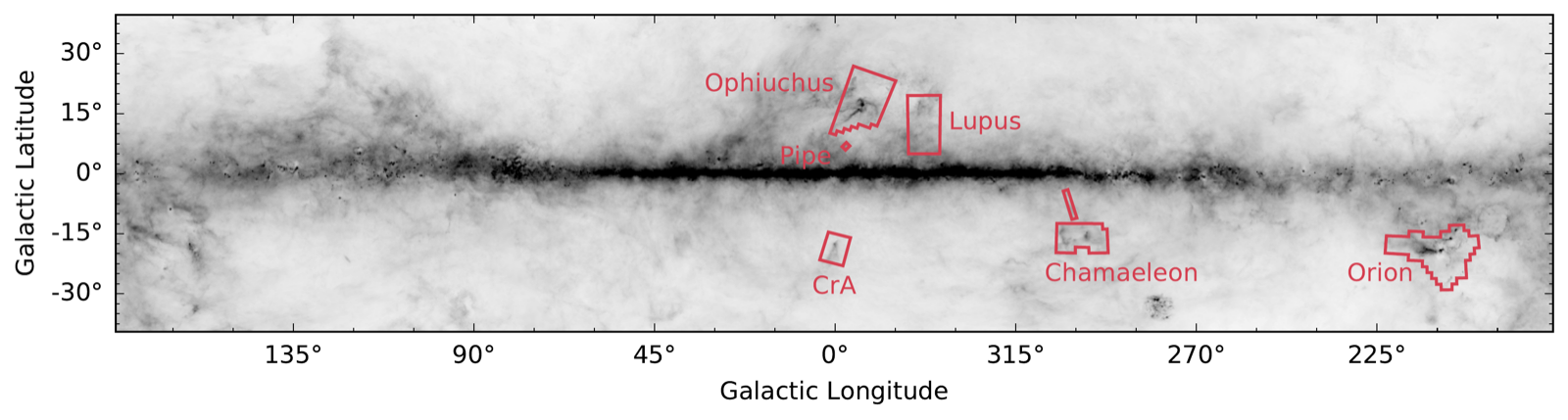
- Ophiuchus
- Pipe Nebula
- Lupus
- Corona Australis
- Chamaeleon-Musca
- Orion
Science goals
We designed the survey to study the interstellar medium and the formation of stars, clusters, and planetary systems.
- 3D distribution of the star-forming interstellar medium and the Milky Way context
- Molecular cloud formation and evolution
- A reliable look into the CMF/IMF relation and the origin of the IMF
- Resolved Kennicutt-Schmidt relation, down to 0.1 pc
- Proper motions of embedded objects and young stars
- YSO identification, characterization, and a precise evolutionary sequence
- Dust properties and reddening law variations
- Cluster formation and evolution
- The IMF down to the brown-dwarf and planet regime
- Wide binaries
- Jets and outflows
- Effects of young stars on protoplanetary disks
VISIONS among the VISTA surveys
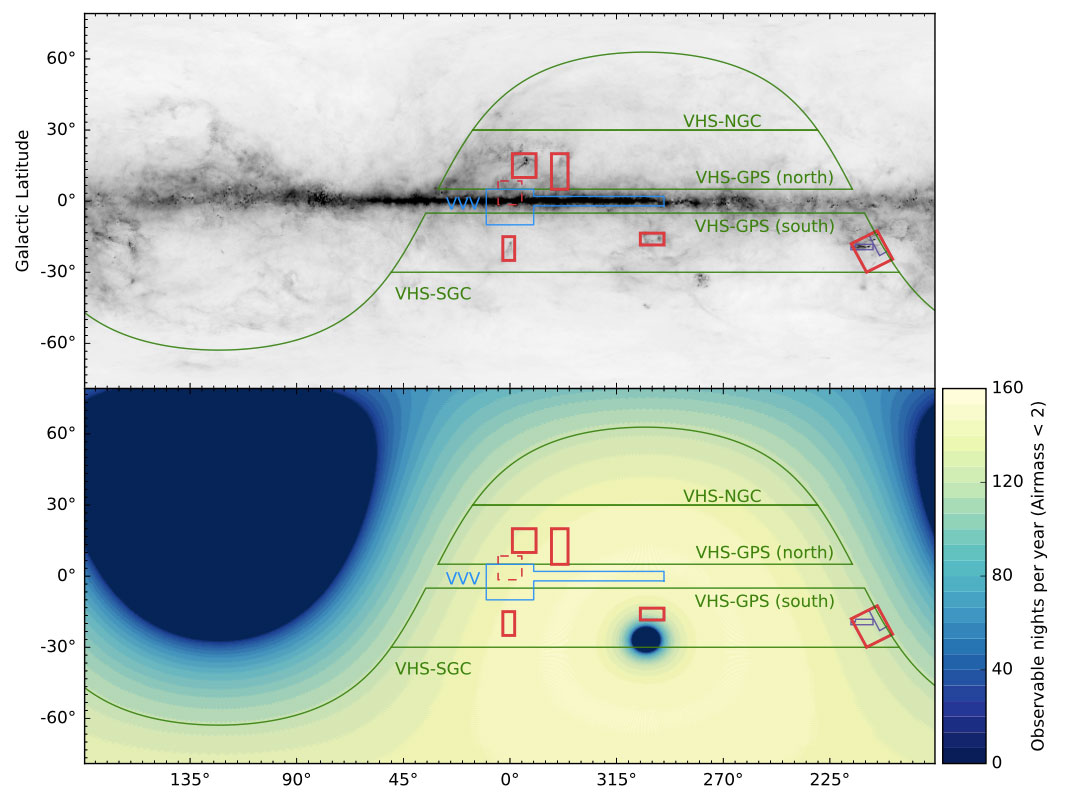
553 hours with VISTA
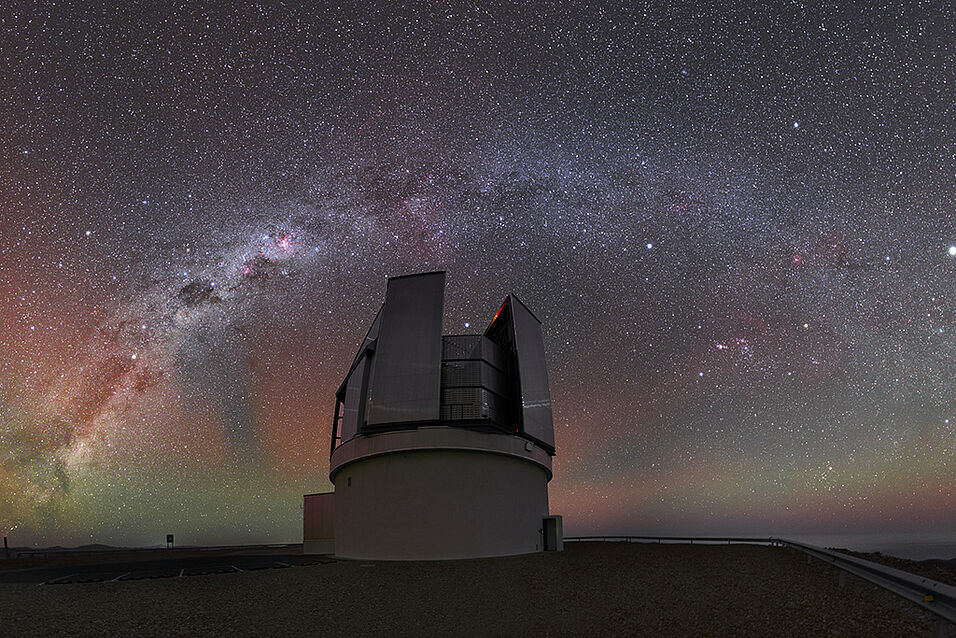
VISIONS is a public survey of the European Southern Observatory, carried out with the 4.1 m Visible and Infrared Survey Telescope for Astronomy (VISTA) at Paranal Observatory in Chile. In total, ESO granted 553 hours of observing time with the VIRCAM camera, distributed over the observing periods P99 to P108 (2017 to 2022).
The survey design builds on VISION, the Vienna survey in Orion, which mapped the Orion A cloud with VISTA and served as the pilot study for the atlas (Meingast et al. 2016).