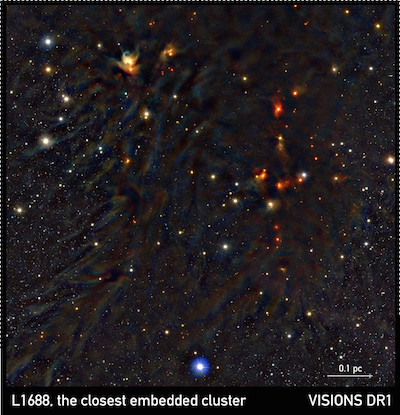
Milestones from VISIONS, from the first allocation of observing time in 2016 to the survey papers in 2023.
17 March 2023
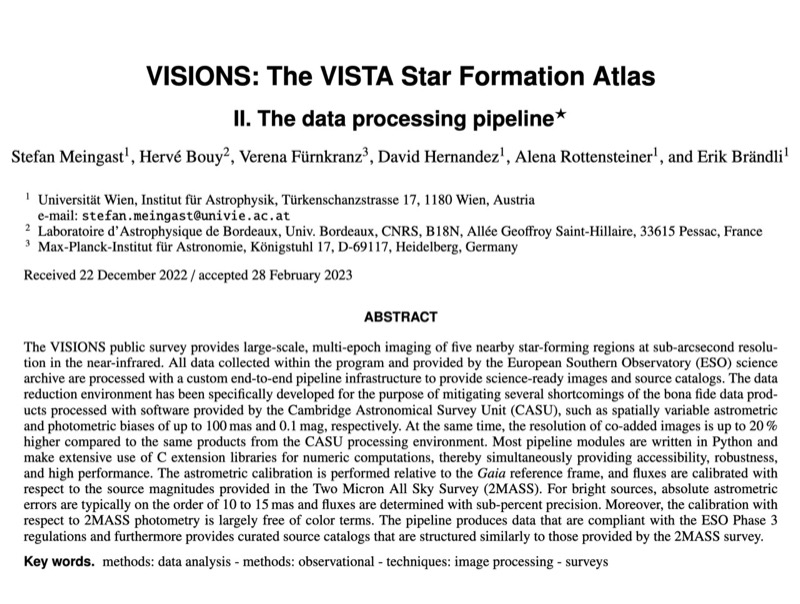
VISIONS pipeline paper publication
The second paper in the VISIONS series has been accepted for publication in Astronomy & Astrophysics, with an open access version available at arXiv.org. The manuscript contains a detailed description of the algorithms implemented in the data processing pipeline vircampype. The pipeline is written in Python and makes heavy use of C extension libraries for vectorized computations. The source code can be downloaded at github.com/smeingast/vircampype.
17 March 2023
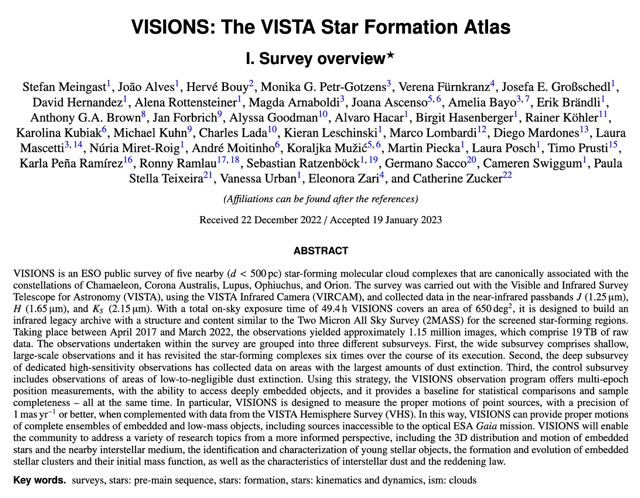
VISIONS survey paper publication
The first paper in the VISIONS series has been accepted for publication in Astronomy & Astrophysics, with an open access version available at arXiv.org. The paper contains a general description of the survey, including its design philosophy, the observed fields, the observing strategy, and a broad overview of the scientific rationale.
28 February 2022
VISIONS Data Release 2
Today, we released the second batch of observations from the VISTA Star Formation Atlas, comprising 840 GB in data volume.
This data release contains all collected observations from April 2017 to October 2021 on the Corona Australis star-forming region. In total, we submitted 3360 files that were constructed from 72 336 individual images and comprise contiguous tiles, stacked pawprints, corresponding weight maps, and source tables. The area covered amounts to about 43 square degrees. All data were processed with a newly implemented pipeline environment operated at the University of Vienna that will also be used for subsequent data releases.
Astrometric calibration was performed with respect to Gaia EDR3, resulting in a typical dispersion of about 15 to 20 mas. Photometric calibration relies on a direct comparison to 2MASS, with statistical and systematic uncertainties at the percent level or better for bright sources. The sensitivity limits reach up to 21.8 mag, 21.1 mag, and 19.9 mag in the J, H, and Ks passbands, respectively. Image quality is excellent throughout the entire survey, with most data featuring point source FWHMs better than 1 arcsec. All data are available through the ESO Archive Science Portal.
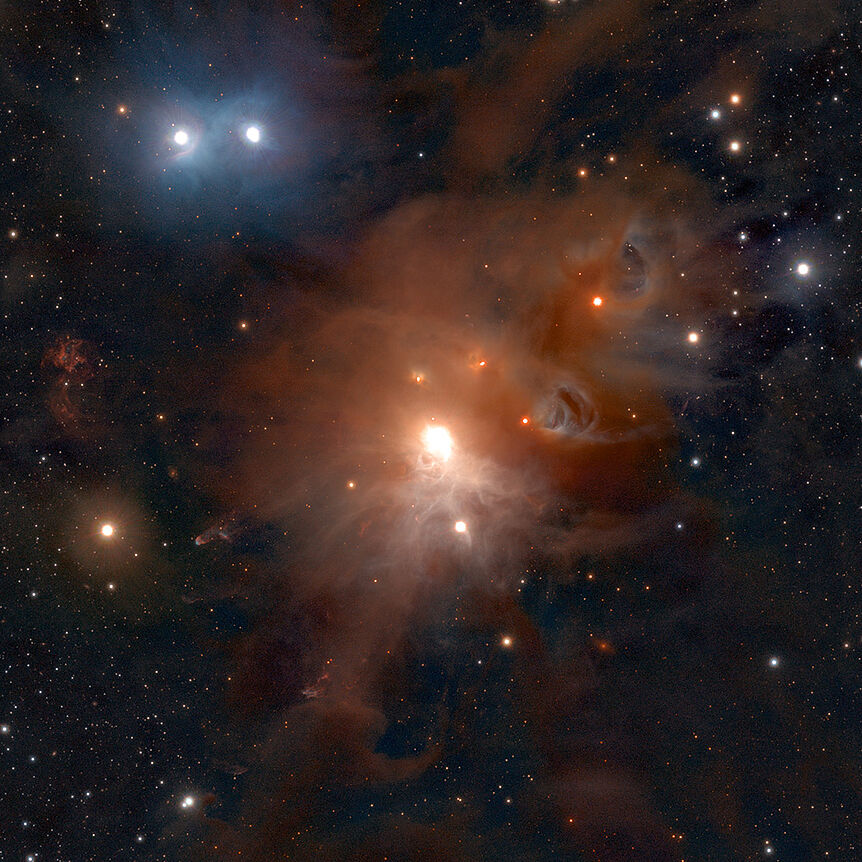
Corona Australis in VISIONS Data Release 2.
1 October 2021
Backup for VISIONS DR2 and beyond
The VISIONS team in Vienna is working hard to publish the next iteration of images and source catalogs in the upcoming second data release (DR2). Alena Rottensteiner, a master student at the University of Vienna, joins the consortium to ensure a timely publication and a robust review of the quality of the future data release contents.
Alena’s work focuses on the daunting task of extending the VISIONS horizon by including additional survey data into VISIONS, specifically data from the parallel VISTA VHS survey. In addition, she will also help with creating quality control plots for the VISIONS survey papers that are planned for publication alongside DR2.
DR2 itself will include all data collected by VISIONS on the Corona Australis star-forming region, corresponding to about 70 000 individual images. The entire field is about 40 square degrees in size, translating to a whopping 4.5 gigapixels at the survey’s pixel scale of 0.333 arcsec/pix.
Alena Rottensteiner
27 September 2021
P108 time allocation
The time allocation process for Period 108 (October 2021 to March 2022) has been completed. VISIONS received approximately 11 hours of observing time, most likely the last allocation for the survey.
After completing the core program already a few months ago, the consortium asked for a minor extension of the program, in order to observe one extra epoch in deep fields. The team expects this minor extension of the survey to have a lasting impact, because these observations will cover the heart of the star-forming regions. There, optical surveys have little chance at capturing the light of the heavily dust-enshrouded baby stars, and with these few extra data, VISIONS will be able to provide even more precise proper motion measurements for the youngest stars.
10 March 2019
Data Release 1
On March 10th, the VISIONS team, together with ESO, finished the first batch in a series of data releases. In this first release, deep NIR photometry of the Ophiuchus star-forming region, along with a control field, is included. Data access and the release documentation are available via the ESO release announcement.
The VISIONS team is already working hard on the next data release, scheduled about a year after Data Release 1.
23 December 2016
P99 time allocation
The time allocation process for Period 99 (April to September 2017) has been completed. The first time allocation, 87 hours of observing time of a total of 553 hours, has been granted to our survey and will be used to observe several target regions. For Ophiuchus, Lupus, and the Chamaeleon star-forming complex, we will finish our first epoch of the wide field observations. The wide field for Corona Australis will even be observed twice in this semester. In addition, we will target the high column-density regions in Ophiuchus for deep observations, as well as a nearby extinction-free control field.
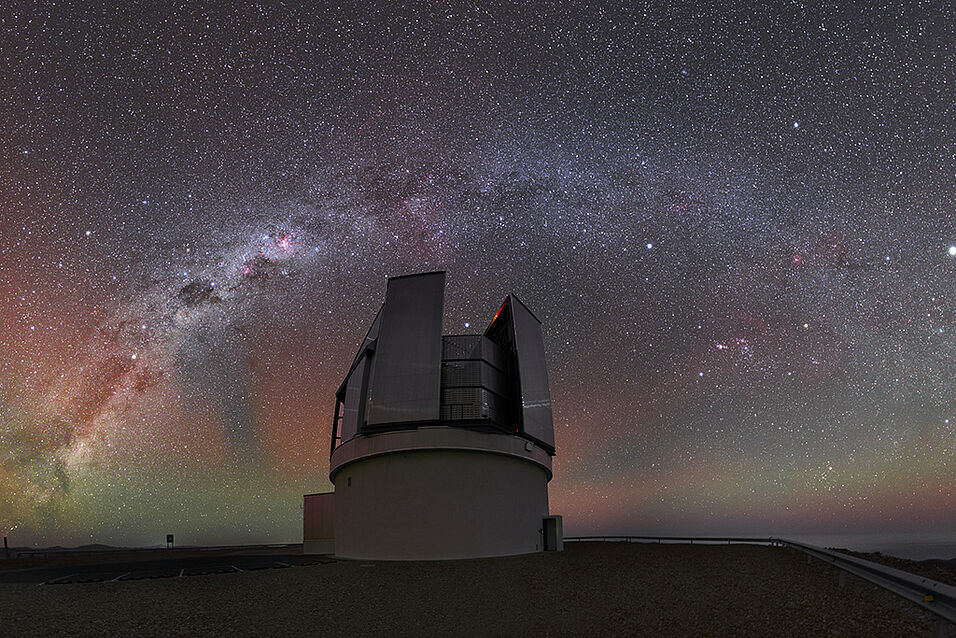
Credit: ESO
VISIONS is a public survey of the European Southern Observatory, led at the University of Vienna.